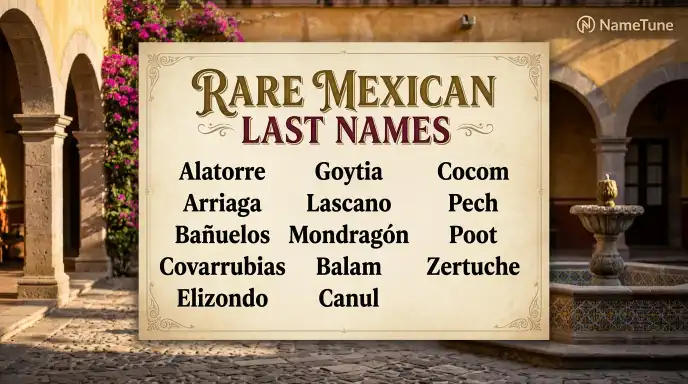
Rare Mexican last names include distinctive family names shaped by Spanish, Indigenous, regional, and historical influences. Some are linked to old places, family occupations, nature, or ancestral roots. This guide explores uncommon Mexican surnames, their possible meanings, and the cultural backgrounds that make them interesting.
What Makes a Mexican Last Name Rare?
A Mexican surname may be considered rare because it is uncommon in everyday use, has a limited regional presence, or comes from a specific family or linguistic tradition. Some names have Spanish roots, while others reflect Indigenous languages such as Nahuatl, Maya, and Zapotec.
However, rare does not always mean ancient or uniquely Mexican. Many surnames also appear in Spain and other Latin American countries. Their history in Mexico may come from migration, colonial records, or local family traditions.
Rare Mexican Last Names With Distinctive Roots
These surnames offer a starting point for readers interested in less familiar family names. Their origins and meanings can vary by spelling, region, and historical record.
| Last Name | Possible Origin or Association |
| Abarca | Spanish surname associated with traditional footwear |
| Alatorre | Spanish surname with a place name structure |
| Arriaga | Basque origin surname |
| Bañuelos | Spanish surname associated with place names |
| Castañeda | Spanish surname connected with chestnut trees or places |
| Covarrubias | Spanish place name surname |
| Echeverría | Basque origin surname |
| Elizondo | Basque origin surname |
| Figueroa | Spanish surname associated with fig trees |
| Goytia | Basque origin surname |
| Ibarra | Basque origin surname associated with a valley |
| Lascano | Basque associated surname |
| Mondragón | Spanish and Basque place name association |
| Ochoa | Basque origin family name |
| Urrutia | Basque origin surname associated with a location |
Important: These are uncommon sounding examples, not a verified ranking of Mexico’s rarest surnames. Some may be more common in particular regions or family lines.
Rare Spanish Origin Mexican Surnames
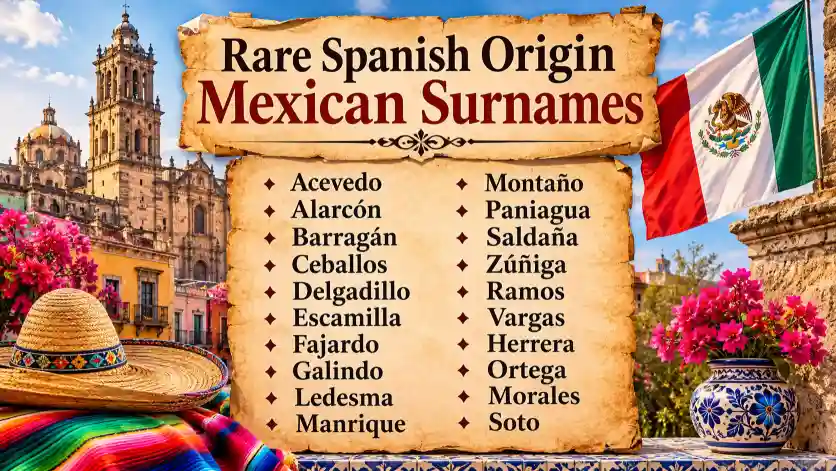
Spanish origin family names are part of Mexico’s long naming history. Some developed from towns, landscapes, occupations, or family identifiers. Others entered Mexican communities through migration and became established across generations.
Distinctive Surnames With Spanish Roots
| Surname | Origin or Meaning |
| Acevedo | Associated with a place where holly grows |
| Alarcón | Spanish place name surname |
| Barragán | Spanish surname with regional historical roots |
| Beristáin | Basque associated family name |
| Ceballos | Spanish surname associated with a place name |
| Delgadillo | Spanish surname derived from a diminutive form of Delgado |
| Escamilla | Spanish place name surname |
| Fajardo | Spanish family name |
| Galindo | Spanish surname with medieval roots |
| Ledesma | Spanish place name surname |
| Manrique | Spanish surname with historical family associations |
| Montaño | Associated with mountains or mountainous places |
| Paniagua | Spanish surname with a historical place name association |
| Saldaña | Spanish place name surname |
| Zúñiga | Spanish and Basque historical surname |
These names can be useful for family history research, character naming, or anyone exploring Spanish influenced Mexican heritage. A surname’s linguistic origin does not establish the ancestry of every family that carries it.
Rare Mexican Last Names With Indigenous Connections
Mexico has a rich range of Indigenous languages and naming traditions. Some surnames have roots in Nahuatl, Maya, Zapotec, and other regional languages. Others reflect Indigenous place names or family histories that became surnames over time.
Nahuatl Influenced Family Names
Nahuatl is one of Mexico’s major Indigenous languages. Several family names and place derived surnames are connected with Nahuatl words and historical communities.
| Surname or Name | Cultural or Linguistic Association |
| Cuauhtémoc | Nahuatl personal name meaning descending eagle |
| Xochitl | Nahuatl word associated with flower |
| Xochipilli | Nahuatl name associated with flowers and beauty |
| Técatl | Nahuatl derived name element found in historical names |
| Tlaloc | Name of an important Aztec rain deity |
A naming distinction matters here: Some entries are Indigenous personal or historical names rather than established examples of rare Mexican hereditary surnames. They should not all be presented as verified family names.
Maya and Southern Mexican Naming Traditions
Maya languages have a strong presence in southeastern Mexico, especially the Yucatán Peninsula and neighboring areas. Family names from this region can preserve local linguistic and community histories.
Examples worth exploring include:
- Balam – A Maya word meaning jaguar.
- Chan – A surname found in Maya speaking communities.
- Canul – A family name associated with Yucatec Maya heritage.
- Cocom – A historical Maya family name.
- Cupul – A surname associated with Maya regional history.
- May – A surname found in Yucatán and other Maya influenced communities.
- Pech – A family name associated with Yucatec Maya heritage.
- Poot – A surname found in Maya speaking regions.
- Tut – A family name found in parts of the Maya world.
These examples are particularly relevant to readers researching family roots in Yucatán. Exact meanings and family histories should be checked against regional linguistic and genealogical sources.
Uncommon Mexican Surnames From Regional Traditions
Mexico’s regions have different histories of settlement, migration, and language contact. As a result, some surnames have stronger connections with particular areas than others.
Yucatán and the Peninsula
Family names associated with Maya speaking communities:
- Balam
- Canul
- Cocom
- Cupul
- Pech
- Poot
- Dzib
- May
Northern Mexico and Border Regions
Names shaped by Spanish settlement and regional migration:
- Samaniego
- Vizcarra
- Elizondo
- Arriaga
- Aguirre
- Montemayor
- Quintanilla
- Zertuche
Central and Western Mexico
Spanish and Basque influenced family names:
- Covarrubias
- Montaño
- Zúñiga
- Larios
- Villaseñor
- Valdivia
- Castañeda
- Orozco
Regional associations are useful research clues, not proof that every family with one of these surnames comes from that region.
Rare Mexican Last Names That Sound Elegant
Some family names stand out because of their rhythm, length, or traditional spelling. These choices may appeal to writers, researchers, and people looking for distinctive surname ideas.
| Last Name | Distinctive Feature |
| Alatorre | Strong, memorable sound |
| Arriaga | Short and refined |
| Covarrubias | Long, traditional structure |
| Echeverría | Distinctive Basque spelling |
| Elizondo | Smooth pronunciation |
| Figueroa | Familiar Spanish elegance |
| Lascano | Compact and uncommon sounding |
| Mondragón | Strong historical character |
| Montemayor | Traditional, place based feel |
| Villaseñor | Recognizable Spanish structure |
For a realistic family history project, check the surname’s documented regional use rather than relying on how unusual it sounds.
How to Choose a Rare Mexican Family Name
The right surname depends on what you want to discover or represent. A name connected to a specific region may be more useful for genealogy than one chosen only for its sound.
Consider these points before choosing:
- Family history: Look for surnames connected to your family’s known ancestors.
- Regional roots: Consider names associated with Yucatán, Oaxaca, Jalisco, or northern Mexico.
- Language: Explore Spanish, Basque, Nahuatl, and Maya linguistic backgrounds.
- Spelling: Pay attention to accents and historical spelling changes.
- Authenticity: Check reliable records before assigning a specific meaning or origin to a surname.
A distinctive surname becomes more meaningful when its history can be traced to a real family, place, or language.
Rare Mexican Last Names for Family History Research
Some surnames stand out because they are connected to particular regions, family histories, or older naming traditions. Researching a rare Mexican surname can help uncover details about a family’s ancestry and migration history.
A surname alone cannot confirm someone’s exact background. However, comparing family records, birth certificates, church documents, and regional histories can provide useful clues.
Surnames Worth Researching
- Aguirre: A surname with Basque roots, found in different parts of Mexico.
- Arriaga: A Spanish surname associated with Basque naming traditions.
- Balam: A Maya word meaning “jaguar,” also used as a surname in the Yucatán region.
- Canul: A surname associated with Maya communities in southeastern Mexico.
- Cocom: A family name with historical connections to Maya traditions.
- Covarrubias: A Spanish surname found in Mexican family histories.
- Elizondo: A surname of Basque origin that appears in northern Mexico.
- Pech: A surname associated with Maya naming traditions.
- Poot: A family name found in Yucatán and other parts of southeastern Mexico.
- Zertuche: A surname with Basque roots found in Mexican records.
Rare Mexican Last Names and Their Cultural Significance
Mexican surnames reflect a combination of Spanish, Indigenous, and regional influences. Their significance often comes from language, geography, family traditions, and historical movement.
Spanish and Basque Heritage
Many Mexican family names have Spanish origins, including surnames connected to Basque speaking regions. Names such as Elizondo, Arriaga, Aguirre, and Urrutia are examples of surnames associated with this heritage.
Their presence in Mexico reflects centuries of migration and settlement. Family records can help establish when a particular surname entered a family line.
Indigenous Heritage and Regional Identity
Indigenous naming traditions remain an important part of Mexico’s cultural history. Maya surnames such as Balam, Canul, Cocom, Pech, and Poot are particularly associated with the Yucatán Peninsula.
These names can reflect longstanding regional identities. Their spelling and pronunciation may also preserve linguistic features from Indigenous languages.
How to Research the Origin of a Rare Mexican Surname
Finding the background of an uncommon surname requires more than checking a name’s meaning. Reliable family records and regional evidence are essential for understanding its history.
- Start With Family Documents: Review birth certificates, marriage records, baptism documents, and older family papers.
- Identify the Family’s Region: Determine the Mexican state, town, or community where earlier generations lived.
- Check Historical Records: Church registers, civil registration documents, and census materials can help trace family connections.
- Compare Spelling Variations: Older documents may show different spellings because of handwriting, transcription, or regional pronunciation.
- Explore Language and Heritage: Research if the surname has Spanish, Basque, Maya, or another linguistic connection.
- Confirm Family Connections: Compare dates, locations, and relatives across multiple records instead of relying on a surname meaning alone.
Frequently Asked Questions
Q.1: What Are Some Rare Mexican Last Names?
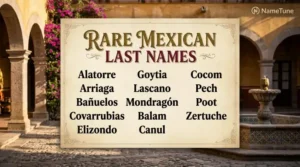
Some less commonly encountered Mexican surnames include Alatorre, Bañuelos, Covarrubias, Elizondo, Goytia, Lascano, Mondragón, Pech, Poot, and Zertuche. Their frequency can vary considerably by region.
Q.2: What Mexican Last Names Have Indigenous Origins?
Balam, Canul, Cocom, Pech, and Poot are associated with Maya naming traditions. Their use is particularly connected with southeastern Mexico and the Yucatán Peninsula.
Q.3: What Mexican Surnames Have Basque Origins?
Examples include Aguirre, Arriaga, Elizondo, Urrutia, and Zertuche. These surnames have connections to Basque naming traditions and can be found in Mexican family histories.
Q.4: Are Rare Mexican Last Names Connected to Specific Regions?
Some surnames have strong regional associations. For example, several Maya family names are found in the Yucatán Peninsula, while other surnames appear in northern or central Mexican records. A regional association does not mean a surname belongs exclusively to one area.
Q.5: How Can I Find the Meaning of My Mexican Last Name?
Begin with the surname’s spelling and possible linguistic roots. Then compare its history with family documents, regional records, and historical sources. A surname’s meaning should be verified through reliable evidence rather than assumed from its appearance.
Final Thoughts
Rare Mexican last names offer an interesting view of the country’s diverse family and cultural history. From Spanish and Basque influences to Maya naming traditions, these surnames can carry connections to language, geography, and generations of family heritage.
The most meaningful way to understand an uncommon surname is to explore its documented history alongside the family and region connected to it. This approach provides a more accurate picture than relying on a name’s meaning or rarity alone.
SEE MORE!

I enjoy exploring names, their meanings, and origins. Through simple guides, I help readers discover unique and meaningful names.