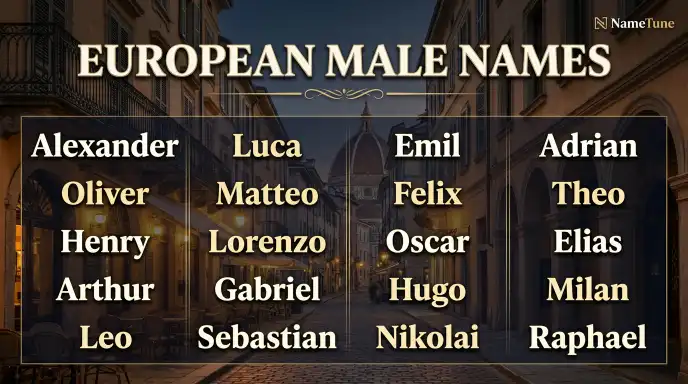
European male names come from a wide range of languages, cultures, and historical traditions. Names such as Oliver, Luca, Mateo, Alexander, and Leon are recognized across different parts of Europe, while choices like Alistair, Soren, and Matteo offer distinctive regional character. This guide explores popular, traditional, and unique European male names, along with options from individual countries and their meanings.
Popular European Male Names
Popular European male names often have familiar pronunciations, strong historical roots, and broad appeal. Some are common across several countries, while others remain closely associated with particular languages and cultures.
Classic and Widely Recognized Names
- Alexander: Defender of humanity, with Greek origins.
- Oliver: Often associated with the olive tree and peace.
- Daniel: God is my judge, with Hebrew origins.
- Thomas: Twin, derived from an Aramaic name.
- Leon: Lion, a name used in several European languages.
- Arthur: A traditional name associated with British legend.
- Nicholas: Victory of the people, from Greek roots.
- Sebastian: Venerable or revered, derived from Greek.
- Henry: Ruler of the home, with Germanic origins.
- Edward: Wealthy guardian, traditionally used in England.
Modern European Favorites
- Luca: A popular Italian form of Luke, often associated with light.
- Mateo: A Spanish form of Matthew, meaning gift of God.
- Leo: Lion, a short and widely recognized European name.
- Theo: A short form of Theodore, meaning gift of God.
- Finn: A name of Irish origin associated with fair or white.
- Hugo: Mind or intellect, with Germanic roots.
- Milan: A Slavic name associated with graciousness or dear qualities.
- Emil: A name derived from the Roman family name Aemilius.
- Felix: Happy, fortunate, or successful.
- Oscar: A name with historic use across several European countries.
Traditional European Male Names
Traditional European male names often reflect royal families, religious history, classical literature, and generations of family naming customs. These choices can suit parents who prefer names with a long standing cultural presence.
Traditional Names With Historic Roots
- William: A Germanic name meaning resolute protector.
- Frederick: Peaceful ruler, derived from Germanic elements.
- George: Farmer or earthworker, from Greek origins.
- Francis: Associated with the French or a French person.
- Louis: A French form of a Germanic name meaning famous warrior.
- Peter: Rock or stone, derived from Greek.
- Joseph: God will add, with Hebrew origins.
- Antoine: The French form of Anthony, a historic Roman name.
- Giovanni: The Italian form of John, meaning God is gracious.
- Miguel: The Spanish and Portuguese form of Michael.
Old Fashioned Names Making a Comeback
- Arthur: A historic name with strong British associations.
- Alfred: Elf counsel, derived from Old English.
- Otto: Wealth or fortune, with Germanic roots.
- Hugo: Mind or intellect, a historic name used in several countries.
- Edmund: Prosperous protector, from Old English.
- Theodore: Gift of God, derived from Greek.
- Felix: Happy or fortunate, used since ancient Roman times.
- August: Great or venerable, connected with the Roman title Augustus.
- Oscar: A traditional name that remains familiar throughout Europe.
- Victor: Conqueror, derived from Latin.
Unique European Male Names
Unique European male names can offer a less familiar sound while retaining meaningful cultural or linguistic connections. Some come from regional traditions, while others are distinctive forms of names used across the continent.
Uncommon Names With European Character
- Alistair: A Scottish form of Alexander, meaning defender of humanity.
- Soren: A Danish form of Severinus, associated with seriousness.
- Leander: Lion man, derived from Greek.
- Caius: An ancient Roman name traditionally associated with rejoicing.
- Stellan: A Scandinavian name with uncertain etymology.
- Bastien: A shortened French form of Sebastian.
- Ivo: A name used in several European languages, traditionally associated with yew.
- Nils: A Scandinavian form of Nicholas, meaning victory of the people.
- Lysander: A Greek name meaning liberator.
- Anselm: A Germanic name commonly interpreted as divine protection.
Distinctive Names From Regional Traditions
- Eamon: An Irish form of Edmund, meaning wealthy protector.
- Rhydian: A Welsh name associated with the Welsh word for reddish.
- Bjarne: A Scandinavian name related to the word for bear.
- Cillian: An Irish name with uncertain meaning and traditional roots.
- Dimitri: A Slavic form of Demetrius, associated with Demeter.
- Lorenzo: An Italian form of Laurence, meaning from Laurentum.
- Thierry: A French form of a Germanic name associated with people or power.
- Marek: A Central and Eastern European form of Mark.
- Tomasz: The Polish form of Thomas, meaning twin.
- Eirik: A Scandinavian form of Eric, commonly interpreted as eternal ruler.
Italian Male Names
Italian male names are known for their melodic sounds, historic connections, and strong presence in Italian culture. Choices range from familiar classics to distinctive names shaped by Roman history and regional traditions.
Popular Italian Names
- Matteo: The Italian form of Matthew, meaning gift of God.
- Leonardo: A Germanic origin name commonly interpreted as brave lion.
- Lorenzo: From Laurentum, an ancient place name.
- Giovanni: God is gracious.
- Alessandro: The Italian form of Alexander, meaning defender of humanity.
- Francesco: An Italian name traditionally associated with a French person.
- Andrea: A common Italian male name derived from Greek, associated with manliness.
- Marco: The Italian form of Marcus, traditionally connected with Mars.
- Riccardo: A form of Richard, meaning brave ruler.
- Stefano: The Italian form of Stephen, meaning crown or wreath.
Distinctive Italian Choices
- Raffaele: The Italian form of Raphael, meaning God has healed.
- Ettore: The Italian form of Hector, a name from Greek tradition.
- Dante: A shortened form of Durante, meaning enduring.
- Elio: A name associated with the Greek word for the sun.
- Tiziano: An Italian name derived from the Roman family name Titianus.
- Gabriele: The Italian form of Gabriel, meaning God is my strength.
- Cosimo: A name derived from the Greek word kosmos, associated with order or the universe.
- Valerio: A Roman origin name associated with strength or health.
- Nerio: A rare Italian name associated with ancient Roman tradition.
- Aurelio: A name derived from the Latin family name Aurelius, associated with gold.
French European Male Names
French male names range from elegant traditional choices to short, contemporary favorites. Many have roots in Latin, Greek, Germanic, or biblical naming traditions and have developed distinctive French forms over time.
Classic French Names
- Louis: Famous warrior, from Germanic roots.
- Henri: The French form of Henry, meaning ruler of the home.
- Pierre: Rock or stone.
- Jean: The French form of John, meaning God is gracious.
- Étienne: The French form of Stephen, meaning crown or wreath.
- François: Traditionally associated with a French person.
- Philippe: The French form of Philip, meaning friend of horses.
- Antoine: A historic French form of Anthony.
- Jacques: The French form of James.
- Gaspard: The French form of Caspar, traditionally associated with a treasurer.
Modern French Favorites
- Gabriel: God is my strength, a name with biblical origins.
- Raphaël: God has healed.
- Jules: A French form of Julius, an ancient Roman family name.
- Théo: A shortened form of Théodore, meaning gift of God.
- Noé: The French form of Noah.
- Maël: A Breton name commonly associated with a prince or chief.
- Léo: Lion.
- Baptiste: A French name associated with the word baptist.
- Mathis: A French and European form related to Matthew.
- Augustin: A French form of Augustine, associated with the Latin name Augustus.
German Male Names
German male names often feature Germanic linguistic roots, historic family traditions, and familiar European forms. Some are strongly associated with Germany, while others are used throughout German speaking countries.
Traditional German Names
- Friedrich: Peaceful ruler.
- Heinrich: Ruler of the home.
- Wilhelm: Resolute protector.
- Ludwig: Famous warrior.
- Karl: A German form of Charles, traditionally associated with a free man.
- Albrecht: Noble and bright.
- Konrad: Brave counsel.
- Bernhard: Brave as a bear.
- Dietrich: A Germanic name associated with people or power.
- Rudolf: Famous wolf.
Modern German Name Choices
- Paul: Small or humble, derived from Latin.
- Leon: Lion.
- Felix: Happy or fortunate.
- Ben: Often used as a short form of Benjamin.
- Jonas: A form of Jonah, meaning dove.
- Elias: A form of Elijah, meaning my God is Yahweh.
- Finn: A name of Irish origin that is also used in Germany.
- Maximilian: A traditional name associated with the Roman family name Maximilianus.
- Oskar: A German spelling of Oscar.
- Emil: A name derived from the Roman family name Aemilius.
Spanish Male Names
Spanish male names are popular throughout Spain and many Spanish speaking communities. They include traditional choices with religious roots, familiar international names, and distinctive options that reflect Spanish culture.
Popular Spanish Male Names
- Alejandro: The Spanish form of Alexander, meaning defender of humanity.
- Diego: A traditional Spanish name with a debated historical origin.
- Mateo: Gift of God.
- Javier: A name associated with the Basque place name Xavier, meaning new house.
- Miguel: Who is like God?
- Carlos: A Spanish form of Charles, traditionally associated with a free man.
- Pablo: The Spanish form of Paul, meaning small or humble.
- Adrián: The Spanish form of Adrian, associated with the ancient place name Hadria.
- Santiago: A Spanish name derived from Saint James.
- Álvaro: A traditional Spanish name of Germanic origin with a debated meaning.
Distinctive Spanish Name Ideas
- Iker: A Basque name traditionally associated with visitation.
- Gael: A name associated with Gaelic speaking peoples.
- Unai: A Basque name meaning herdsman.
- Nicolás: The Spanish form of Nicholas, meaning victory of the people.
- Hugo: Mind or intellect.
- Thiago: A name related to Santiago and James.
- Damián: The Spanish form of Damian, derived from Greek.
- Rodrigo: A Germanic origin name commonly interpreted as famous ruler.
- Leandro: The Spanish form of Leander, meaning lion man.
- Aitor: A Basque name associated with traditional Basque legend.
Scandinavian Male Names
Scandinavian male names come from Denmark, Norway, Sweden, and nearby Nordic traditions. Many have Old Norse roots, while others are modern forms that remain popular throughout the region.
Traditional Nordic Names
- Erik: An Old Norse name commonly interpreted as eternal ruler.
- Bjorn: Bear, from Old Norse.
- Leif: Heir or descendant, from Old Norse.
- Sven: Young man or boy, with Old Norse roots.
- Ragnar: A traditional Old Norse name associated with warrior history.
- Knut: A Scandinavian form of Canute, traditionally associated with a knot.
- Harald: Army ruler, from Old Norse elements.
- Magnus: Great, derived from Latin.
- Gunnar: A name formed from Old Norse elements associated with battle and warrior.
- Stig: A Scandinavian name associated with a path or journey.
Modern Scandinavian Favorites
- Lars: A Scandinavian form of Laurence.
- Nils: A Scandinavian form of Nicholas, meaning victory of the people.
- Emil: A name derived from the Roman family name Aemilius.
- Axel: A Scandinavian form of Absalom, meaning father of peace.
- Oscar: A name widely used in Nordic countries and beyond.
- Viggo: A Scandinavian name associated with battle or war.
- Arvid: An Old Norse name commonly interpreted as eagle tree.
- Albin: A name derived from Latin, meaning white or bright.
- Frederik: A Danish form of Frederick, meaning peaceful ruler.
- Soren: A Danish form of Severinus, traditionally associated with seriousness.
Greek Male Names
Greek male names connect modern naming traditions with ancient mythology, philosophy, religion, and classical history. Many have meanings rooted in the Greek language and have influenced names used throughout Europe.
Classic Greek Names
- Alexander: Defender of humanity.
- Nicholas: Victory of the people.
- Theodore: Gift of God.
- Dimitrios: A Greek form of Demetrius, associated with Demeter.
- Andreas: A Greek form of Andrew, associated with manliness.
- Philip: Friend of horses.
- Leonidas: A name associated with the Greek word for lion.
- Constantine: Steadfast or constant.
- Basil: Kingly or royal.
- George: Farmer or earthworker.
Greek Names Inspired by Mythology and History
- Achilles: The name of the legendary Greek hero of the Trojan War.
- Orion: A hunter in Greek mythology and the name of a constellation.
- Atlas: A Titan in Greek mythology associated with bearing the heavens.
- Perseus: A legendary Greek hero known for defeating Medusa.
- Apollo: The Greek god associated with music, prophecy, and healing.
- Evander: A name of Greek origin associated with a good man.
- Damon: A Greek name associated with loyalty through classical legend.
- Leander: Lion man.
- Hector: A name associated with the Trojan hero in Greek epic tradition.
- Adonis: A name connected with a beautiful youth in Greek mythology.
Portuguese Male Names
Portuguese male names share connections with Latin, biblical traditions, and Portuguese history. Some are widely recognized internationally, while others have a distinct sound shaped by Portuguese pronunciation and culture.
Popular Portuguese Names
- João: The Portuguese form of John, meaning God is gracious.
- Miguel: Who is like God?
- Francisco: A name traditionally associated with a French person.
- Pedro: The Portuguese form of Peter, meaning rock or stone.
- António: A Portuguese form of Anthony.
- Rafael: God has healed.
- Gonçalo: A traditional Portuguese name of Germanic origin.
- Tomás: The Portuguese form of Thomas, meaning twin.
- Duarte: The Portuguese form of Edward, meaning wealthy guardian.
- Afonso: A Portuguese name of Germanic origin commonly associated with noble or ready qualities.
Distinctive Portuguese Choices
- Diogo: A traditional Portuguese male name related to Diego.
- Tiago: A Portuguese name related to James.
- Lourenço: The Portuguese form of Laurence.
- Vasco: A historic Portuguese name associated with exploration and maritime history.
- Martim: A Portuguese form of Martin, traditionally connected with Mars.
- Simão: The Portuguese form of Simon, meaning he has heard.
- Nuno: A traditional Portuguese name with an uncertain etymology.
- Salvador: Savior, derived from Latin.
- Bento: The Portuguese form of Benedict, meaning blessed.
- Amadeu: A Portuguese form of Amadeus, commonly interpreted as love of God.
How to Choose the Right European Male Name
Choosing a European male name becomes easier when you consider its meaning, cultural background, pronunciation, and long term appeal. A name that sounds attractive on its own should also fit your personal preferences and intended use.
Consider the Cultural Background
Choose a name that reflects the heritage or language you appreciate. Italian names such as Lorenzo and Matteo have a different sound from Scandinavian choices such as Leif and Erik. French names like Jules and Henri offer another style, while Spanish names such as Alejandro and Javier have their own cultural character.
Check the Meaning and Pronunciation
Some names have direct meanings, while others developed from ancient personal names or place names. Check reliable name references if the exact meaning is important to you. Also consider how the name sounds when spoken in its original language and in your everyday language.
Decide Between Traditional and Modern Styles
Traditional choices such as Friedrich, Giovanni, and Pierre carry a long historical presence. Modern favorites such as Leo, Luca, and Hugo are shorter and familiar across multiple countries. The best choice is one that matches the style, meaning, and cultural connection you want.
Frequently Asked Questions About European Male Names
Q.1: What are the best European male names?
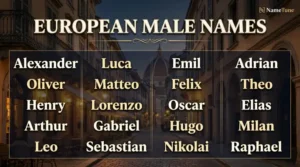
Some excellent European male names include Alexander, Luca, Matteo, Leo, Arthur, Sebastian, Gabriel, Hugo, Adrian, and Raphaël. These choices combine traditional heritage with modern style and international appeal.
Q.2: What are some male names popular around 1900?
Classic male names from the early 1900s include Albert, Walter, Arthur, George, Edward, Henry, Frederick, Ernest, Harold, and Frank. Many were widely used in European and English-speaking communities during that era.
Q.3: Which boy names are popular across Europe?
Names such as Noah, Oliver, Lucas, Leo, Alexander, William, Benjamin, Gabriel, Theo, and Elias are familiar across various European countries. Popularity rankings vary by country and year.
Q.4: What is a rare European male name?
Distinctive European male names include Amaury, Célestin, Isidore, Alaric, Aurelian, and Gaspard. Their popularity differs across regions, so their rarity depends on the country.
Q.5: What are some luxurious European boy names?
Sophisticated choices include Maximilian, Valentino, Leonardo, Laurent, Raphael, Auguste, and Sebastian. Their elegant sounds and historical or cultural associations make them appealing to parents seeking a refined name.
Q.6: Which male names have a strong German heritage?
Traditional German male names include Friedrich, Heinrich, Wilhelm, Wolfgang, Günther, Dietrich, and Ludwig. These names have deep roots in German-speaking history and culture.
Final Thoughts
European male names offer a wide range of choices, from historic classics to modern favorites and distinctive regional names. Alexander, Luca, Matteo, Leon, Erik, Lorenzo, Hugo, and Santiago are useful starting points for exploring different European naming traditions.
Before settling on a name, consider its pronunciation, cultural origin, and meaning. Exploring several countries and languages can help you find a name that feels distinctive while retaining a meaningful connection to European history and culture.
LEARN MORE!

I’m Eleanor Whitmore, a UK based writer who enjoys exploring names, meanings, and their origins. I write simple, helpful guides to make finding the right name easier.